Module

Plan it, fund it, run it, prove it

Every promotion on one calendar, every party’s funding on the same record, and every result measured against a clean baseline — from the vendor-funded event to the shopper’s promo code.

The same problem, stated twice

Once for the person who owns the P&L, once for the person who owns the systems. Neither column is a summary of the other.

The financial problem

Trade spend is the largest line nobody can explain.

  • Promotions are planned in spreadsheets, so a clash on the same item or a blackout breach surfaces after the money is committed.
  • Results are judged against last year’s total, so a promotion that only pulled sales forward, or took them from its neighbors, looks like a win.
  • Vendor and account funding is agreed per event and claimed from memory — money earned goes unclaimed, and money paid lacks its proof.
  • Nobody knows which mechanics work, because a closed promotion leaves nothing the next plan can read.

The technical problem

The plan, the funding and the result live in three places.

  • The calendar is a spreadsheet, the offer is set up in the web shop or the till, and the funding sits in a rebate system — none of them can check the others.
  • Baselines are rebuilt by hand for every review, so two analysts produce two ROIs for the same promotion.
  • Promo codes are priced by the storefront, so the cost of a code never reaches the margin it was meant to protect.
  • A running promotion is changed in place, with no approval and no version to compare.

What RevUpra does

Inside trade promotion management

1

Plan

One promotional calendar

Every promotion and campaign on one week grid, in lanes by category, channel, funding or owner — with overlaps on the same item, blackout dates and lead times flagged before anything is approved.

Campaigns with their own budget

Promotions grouped under one budget envelope: what is promoted, at what depth and mechanic, each line checked against your price and margin floors.

Where it runs

Everywhere, in named stores or accounts, or in price zones, regions and chains — and a clash counts only where the places meet.

Recommended promotions

The promotions worth starting in the next twelve weeks, found in your own data — seasonal peaks, repeat winners, win-backs, tier pushes and supplier-funded events — each one a click from a draft.

2

Forecast & decide

Forecasts, as estimates

Expected units, profit and ROI line by line, from a clean baseline, price elasticity and tactic lifts — with the drivers and the confidence shown.

Scenarios within your limits

Vary the mechanic, depth, weeks, tactics and funding. A candidate that breaks a price floor, margin, budget, funding cap or the calendar is refused; the best of the rest is recommended with its reason, and a person applies it.

3

Fund

Vendor funding on what happened

A lump sum, a rate per unit bought or sold, or a rate per redemption — accrued on the real receipts and sales, and capped at the commitment.

Account funding with proof

Pay an account for a display, feature, listing or placement — claimed only once its proof is verified — or as a billback or scan allowance.

Paid on the result

Funding paid only for what the promotion achieved — its lift, incremental units or ROI — at a threshold or pro rata.

Vendor-funded events

Budget and caps per vendor and item, sponsorships held for your review, bulk agreements with e-signature — and each vendor claimed for the lowest of what it committed, delivered and spent.

4

Shopper offers

Promo codes in every shape

“$X off every $Y”, 2 for $5, buy one get one, bundles and spend tiers — priced line by line, checked on save and shown in a shopper’s words. No code goes live until it is approved.

Loyalty offers and coupons

Offers for shopper segments with a holdout, so their effect is measured; paper coupons scanned by barcode; codes for named stores and shoppers.

Coupon clearing

Claim your coupons back from their maker — face value plus handling, each redemption once — and check a retailer’s redemption file line by line.

5

Run & measure

In flight, against plan

Actual against the plan of record, where it will land, budget burnt against the window elapsed, stock cover and deliverables. Off-plan and overdue alerts become tasks.

Changes go through approval

A new end date, more budget or a changed plan line waits for approval with its reason, and every change is a version you can compare.

Results & ROI for every party

Incremental profit against a clean baseline, net of what the promotion took from its neighbors and with what it lifted — the investment, ROI and break-even lift of whoever ran it.

An outcomes library

Every closed promotion keeps what it did, line by line, for the next plan — and a forecast accuracy report compares each plan with what sold.

The Promotion Advisor

Ask why a promotion is off plan or what it returned, on the screen that shows the figures. It explains them; it does not forecast or decide.

Watch

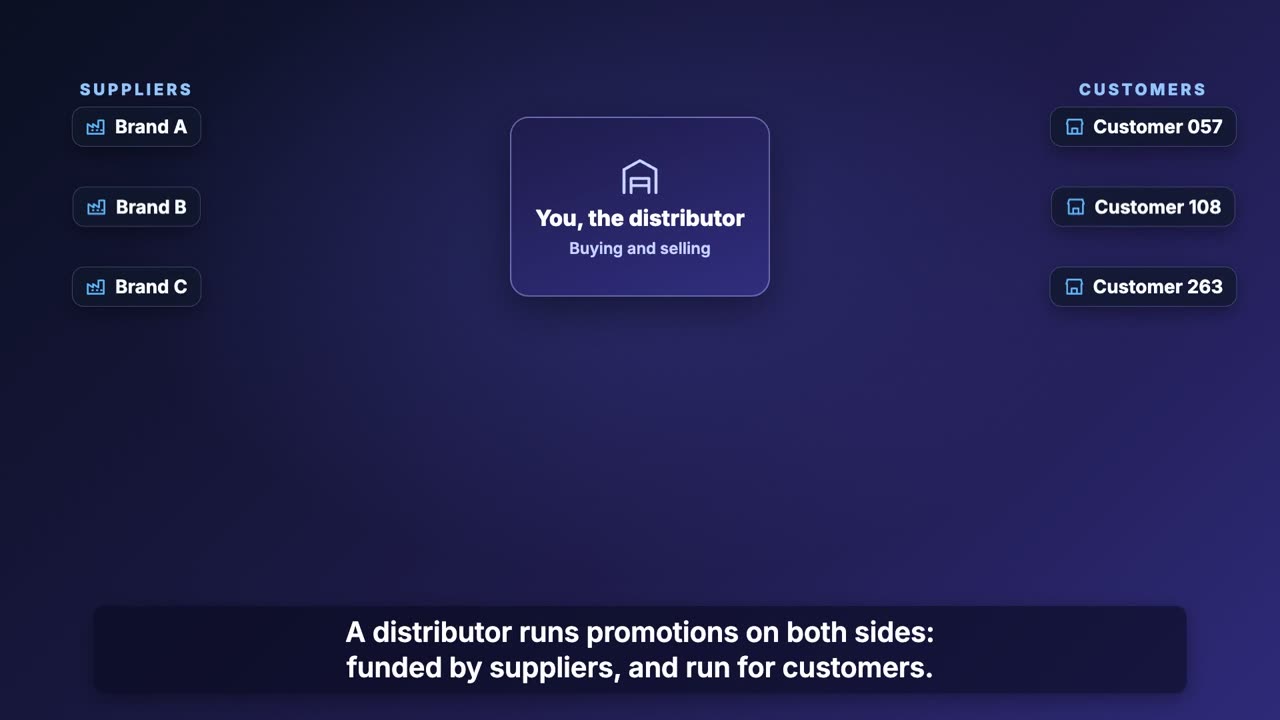
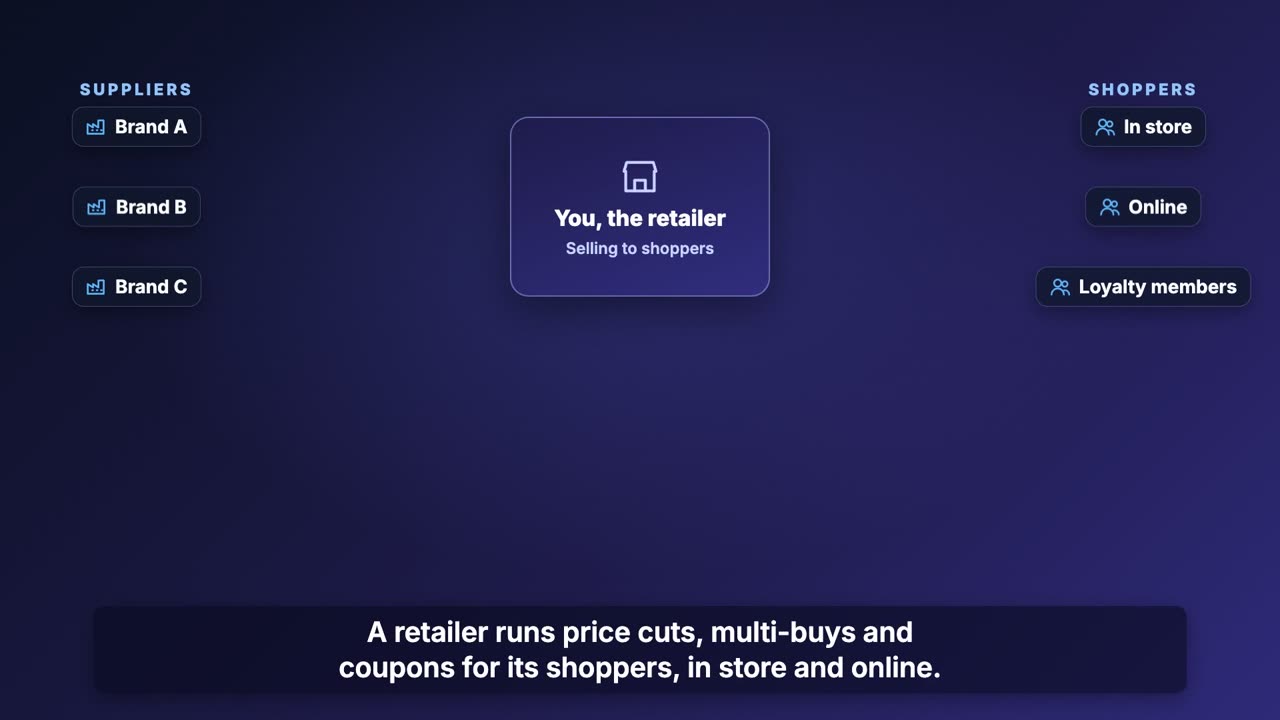
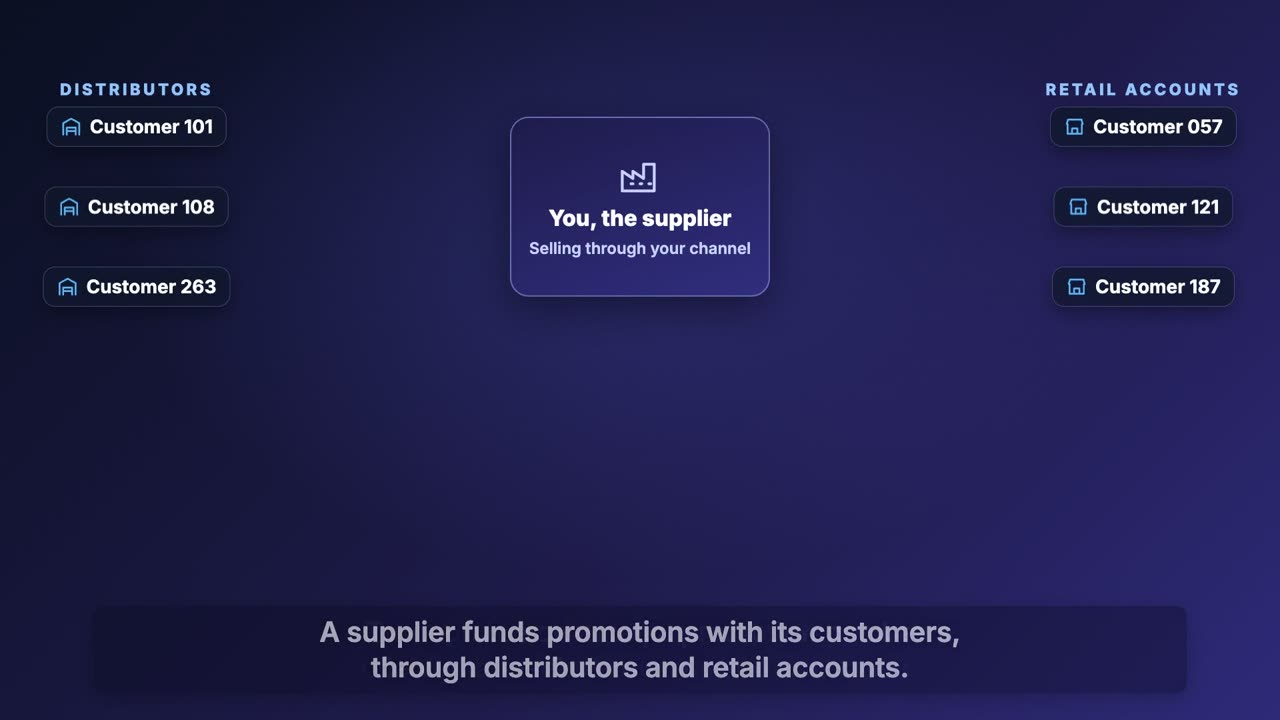
Promotions with your partners, in a minute

The same capability seen from each seat — a distributor, a retailer and a supplier.

More on the RevUpra YouTube channel.

Benchmarks

What good looks like

Use this as a self-assessment. If you cannot produce one of these numbers for your own program, that is itself the finding.

Trade promotion management benchmarks
Metric Typical today Target
Promotions judged against a clean baseline Against last year’s total Every promotion, net of pull-forward and cannibalization
Clashes and blackout breaches found After the money is committed Before approval
Funding claimed with its proof Reconstructed at claim time Claimed only once the proof is verified
Changes to a running promotion Made in place Approved, versioned and comparable
What last year’s promotions returned In someone’s spreadsheet An outcomes library the next plan reads
Ranges are indicative benchmarks drawn from published channel-incentive and pricing research together with our own implementation experience. They vary widely by program complexity, channel depth and data quality — treat them as the opening question in a diagnostic, not a guarantee.

The test of a trade promotion system is whether next year’s plan can read what this year’s promotions actually did — net of what they borrowed from the weeks around them and the items beside them.

Leak points

What this closes

The leak points from our taxonomy that this module addresses directly.

02

Contract drift

“You are operating a version of the deal nobody signed.”

Financially

The signed agreement says one rate; the system was configured with another, or an amendment was agreed by email and never applied. Every transaction from that point is priced or accrued wrongly, and the exposure compounds silently until renewal.

Technically

The contract is a document and the configuration is data, and nothing binds them. Amendments arrive as redlined attachments; applying them to the running configuration is a manual re-keying step with no verification.

Typical cost
0.5% – 2.0% of contracted revenue
Benchmark
Best practice is zero drift — every executed term traceable to the clause that created it.

How it closes: The contract is the front door. Terms are mashed live from the deal, redlined with attribution, executed, and the executed version is what the engine runs.

See the module →
05

Promotion & MDF spend leakage

“The fund was spent. The proof was not collected.”

Financially

Market-development funds are committed against a promotion, drawn down and paid, but the deliverable evidence is thin or missing. Unsupported spend is not recoverable from the vendor and, when audited, is often clawed back.

Technically

Promotions are run in email and spreadsheets: the budget lives in one file, the vendor commitments in another, the proof-of-performance in a folder. There is no object linking money to evidence, so the link is reconstructed manually or not at all.

Typical cost
8% – 20% of MDF & co-op spend
Benchmark
Well-governed programs carry proof-of-performance on >95% of drawn funds.

How it closes: Budget, CAP, vendor commitment, deliverable and claim are one linked object. Funds cannot be drawn past CAP, and evidence is attached to the money.

See the module →
08

Deduction & dispute write-off

“It was cheaper to write it off than to fight it.”

Financially

Customers deduct against invoices for claimed rebates, shortages and pricing disputes. Where the deduction cannot be quickly tied back to an authorization, small balances get written off in bulk — and partners learn that they will be.

Technically

Deductions land in AR with a free-text reason code and no link to the incentive that supposedly justified them. Research is manual, per item, so the cost of investigation exceeds the value of anything small.

Typical cost
0.2% – 0.9% of gross revenue
Benchmark
Strong programs resolve >85% of deduction value without manual research.

How it closes: Deductions are matched to their authorizing claim automatically; only genuine exceptions reach a human, so small balances stop being written off by default.

See the module →

See what RevUpra can recover for you.

Thirty minutes, tailored to your programs. We walk an agreement through modeling, contracting, accrual, claim and settlement using examples close to your own — and model an indicative ROI against your volumes.